
Domes of Gracanica Monastery
The final leg of my travels has been Kosovo, visiting three churches that represent the high point of medieval Serbian art and architecture: the Patriarchate at Pec, and the Monasteries of Christ the Pantokrator (the Decani), and the Dormition of the Mother of God at Gracanica. They were all completed in the mid-1300’s, in the brightest moment of Serbia’s cultural life, when gifted artists from Thessalonica and Constantinople traveled north to adorn these shrines, which were intended as burial places for the empire’s kings and patriarchs. They are roughly contemporaneous with the early Renaissance in Italy and Flanders, and emerge from a time of great social upheaval across Europe.
All three are monumental buildings, and filled with frescoes of the highest quality, and quite well preserved, in spite of attacks in various eras, even into our century. But they are also ambivalent places, because for Kosovo’s overwhelming Albanian majority, they are deeply associated with manipulative and repressive policies of the Serbian government, including the genocidal campaign of the late 1990’s, which resulted in U.N. intervention, and the eventual establishment of Kosovo as an independent state.
Those conflicts were driven by centuries of division within the Church, as well as the Ottoman policy of ruling its citizens as distinct religious groups. There is still deep social division and resentment in Kosovo, and this has been expressed until very recently, in waves of attacks on churches and mosques. I don’t know if I have ever been asked to hand over my passport to an armed guard to visit a monastery, but it happened at two of three sites (Gracanica is in a Serbian enclave and the curator told me that any radical would be risking his life if he tried to make a political statement there).
It certainly must create a challenging set of temptations and distractions for the small religious communities that continue to be based at all three places, and it was a blessing to join the nuns at Gracanica for vespers and to pray for their witness in such a challenging time and place.
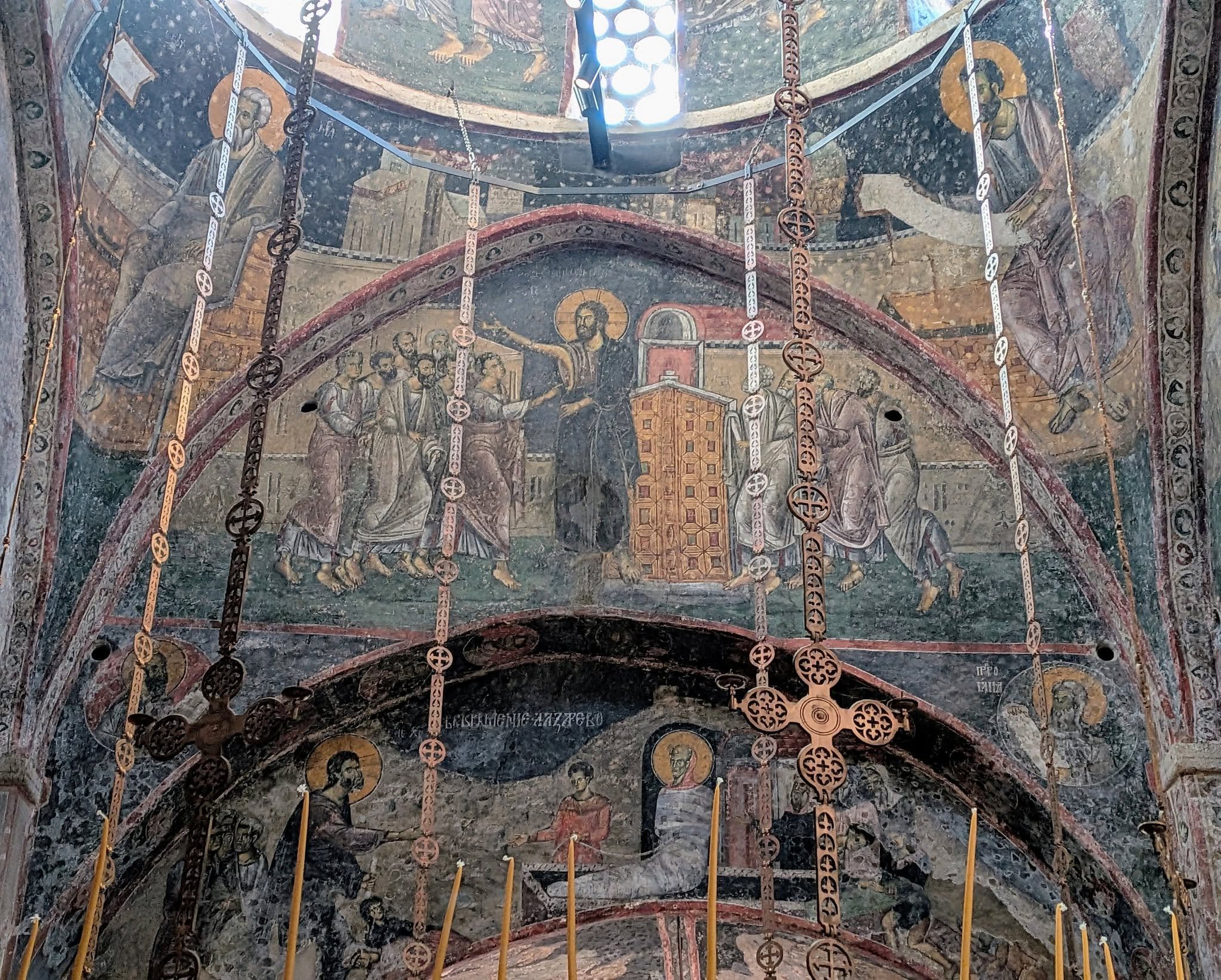


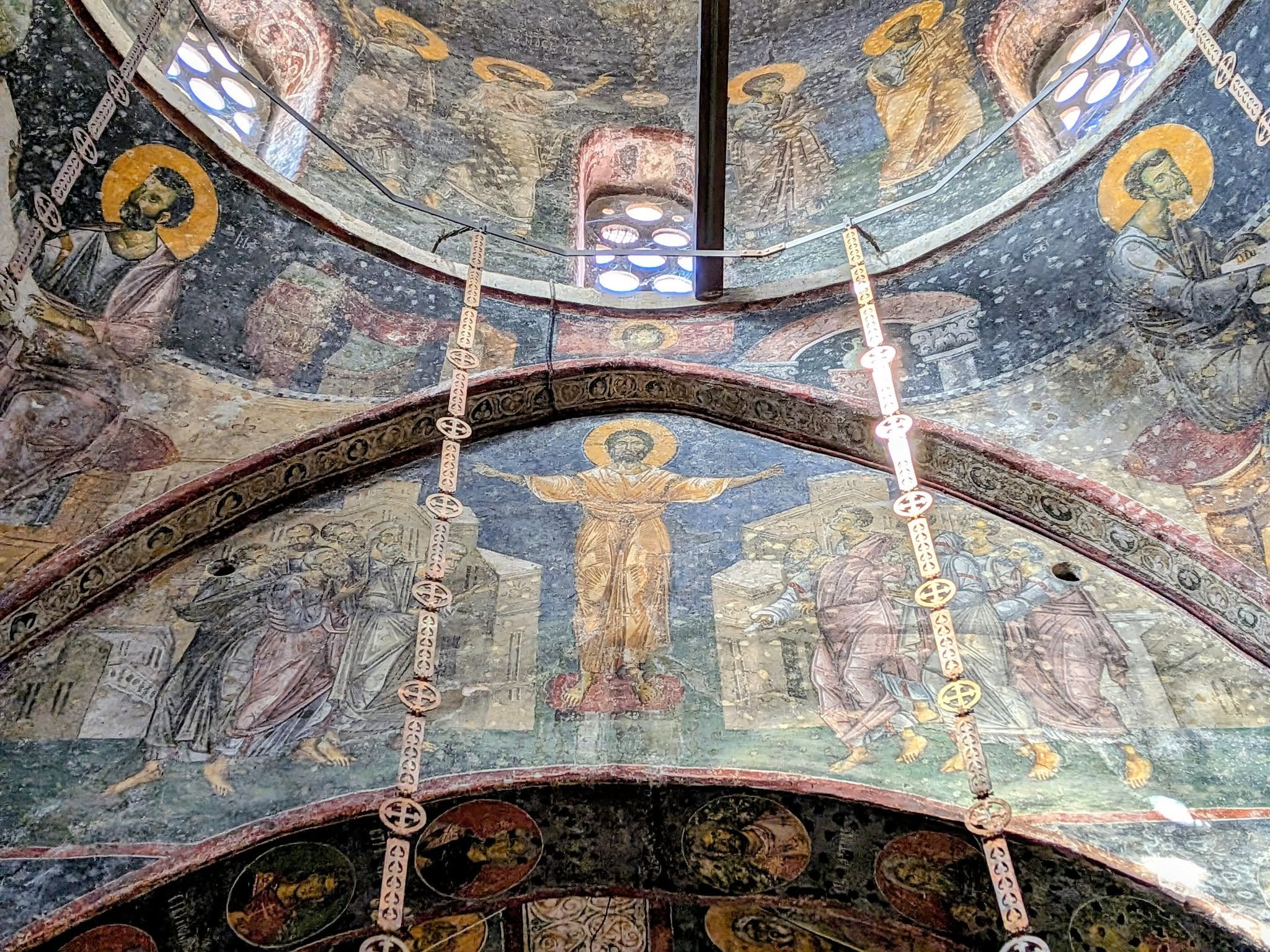

The Patriarchate at Pecs is the oldest of the three, and the most dramatically situated. In the early 1200’s, the oldest church, dedicated to the Holy Apostles, was built, as a refuge for the leader of the Serbian Church, who needed to flee the former headquarters further north at Zica after a series of devastating by the Hungarians. The monastery was situated along the Bistrica River, at the beginning of what becomes the Rugova Gorge, a dramatic cut in the “Accursed Mountains,” a section of the Albanian Alps.
The founding patriarch, Arsenius, designed the main church carefully to make a statement about Serbia’s religious heritage and mission. The church was roughly patterned on Constantinople’s great Church of the Holy Apostles, the burial place of the Byzantine emperors and patriarchs of the Eastern Church, a church that was then in the hands of the Crusaders, at a time when the empire’s future was gravely contested. Arsenius chose an unusual iconographic scheme for the oldest frescoes there, which was probably borrowed from the Zion Monastery in Jerusalem, which he had visited, the place of the Last Supper and Christ’s appearance to the apostles: that was a statement about the call to evangelization, that the Serbian Church (a relatively new one) was charged with making disciples of the surrounding pagans.
Two additional churches were eventually built on the site, one on each side, with a large narthex connecting them at the west end. This unusual feature is borrowed from Mount Athos, even the the Eastern Church’s spiritual center, where the first Serbian patriarch, St. Sabas, had established an important monastery. The whole was painted in red on the outside, another distinctively Athonite tradition.
I was very surprised by the scale of the complex and of the extent of the frescoes, a feature of all three of these sites. There are hundreds, maybe thousands of scenes, recounting the Biblical story, the history of the Church, and the cycle of the liturgical year in exhaustive detail. The entire Menologion, the Orthodox liturgical calendar is there in fresco, an image for every single saint’s day. All sorts of scenes from the Old Testament and the Acts of the Apostles that are rarely treated in Western religious art are shown, and there are frescoes of all the Ecumenical Councils, plus numerous significant regional synods. I had binoculars and some pretty detailed descriptions, and spent about an hour studying the paintings, but I couldn’t really begin to understand them in full. It is truly an encyclopedic vision of the Christian story.
Pecs remained the seat of the patriarchate until the 18th century, when the patriarch, and much of the nobility, fled for Hungary, creating the dynamics that would lead to more recent conflict over the fate of what some still call “Old Serbia.”


To give my eyes a bit of a break, as much as anything else, I drove fairly far up into the Rugova Gorge. The road climbs higher and higher, straddling the cliff edge, before giving out shortly before the Montenegrin border. I had a lovely walk to a series of waterfalls and admired the crystal clear waters of the mountain river. I should have had lunch at one of the little restaurants, that specialize in fresh fish, pulled out of the river, but the timing wasn’t right, and there was more to see.

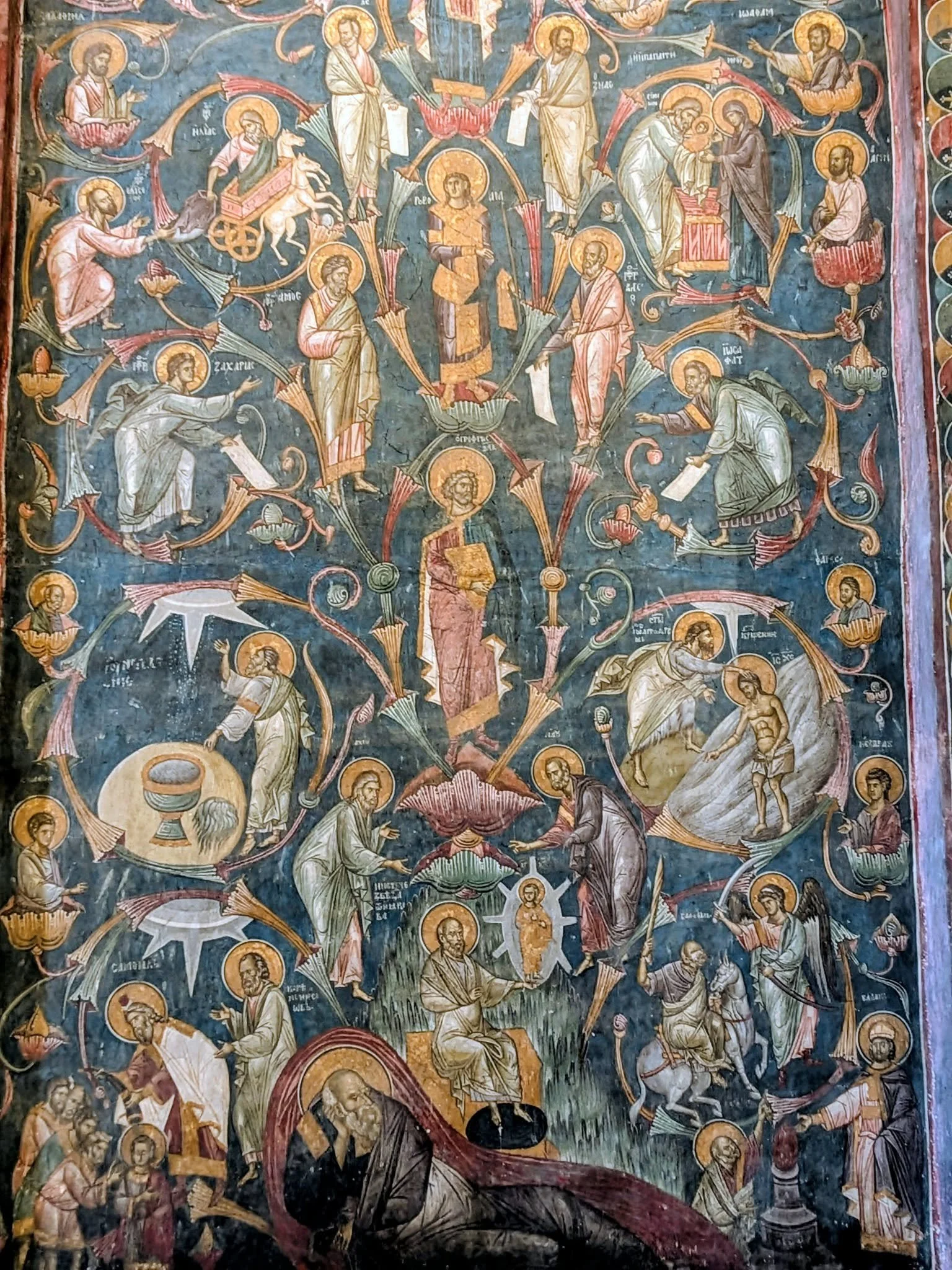


I continued to the Decani Monastery, named for King Stefan Dečanski, its founder, who is buried there. This was my favorite of the three, an immense church (the largest medieval church in the Balkans), and a fascinating fusion of Western and Eastern Christian art. It was designed by Vitus of Cattaro (now Kotor in Montenegro), a Franciscan friar, and from the outside, it’s a model Romanesque church, reminding me most of the great basilicas of Apulia. There are lots of grotesque carvings and beautiful use of alternate stripes of masonry blocks (as in Siena’s Cathedral), but all is perfectly designed for the demands of Orthodox ceremonial. Kotor was then (briefly) a part of the Serbian Empire, a much-desired outlet on the sea. The style was quite old fashioned by then, but there are also a few Gothic arches here and there, and prominent cross-vaulting, which one rarely sees in Byzantine churches.
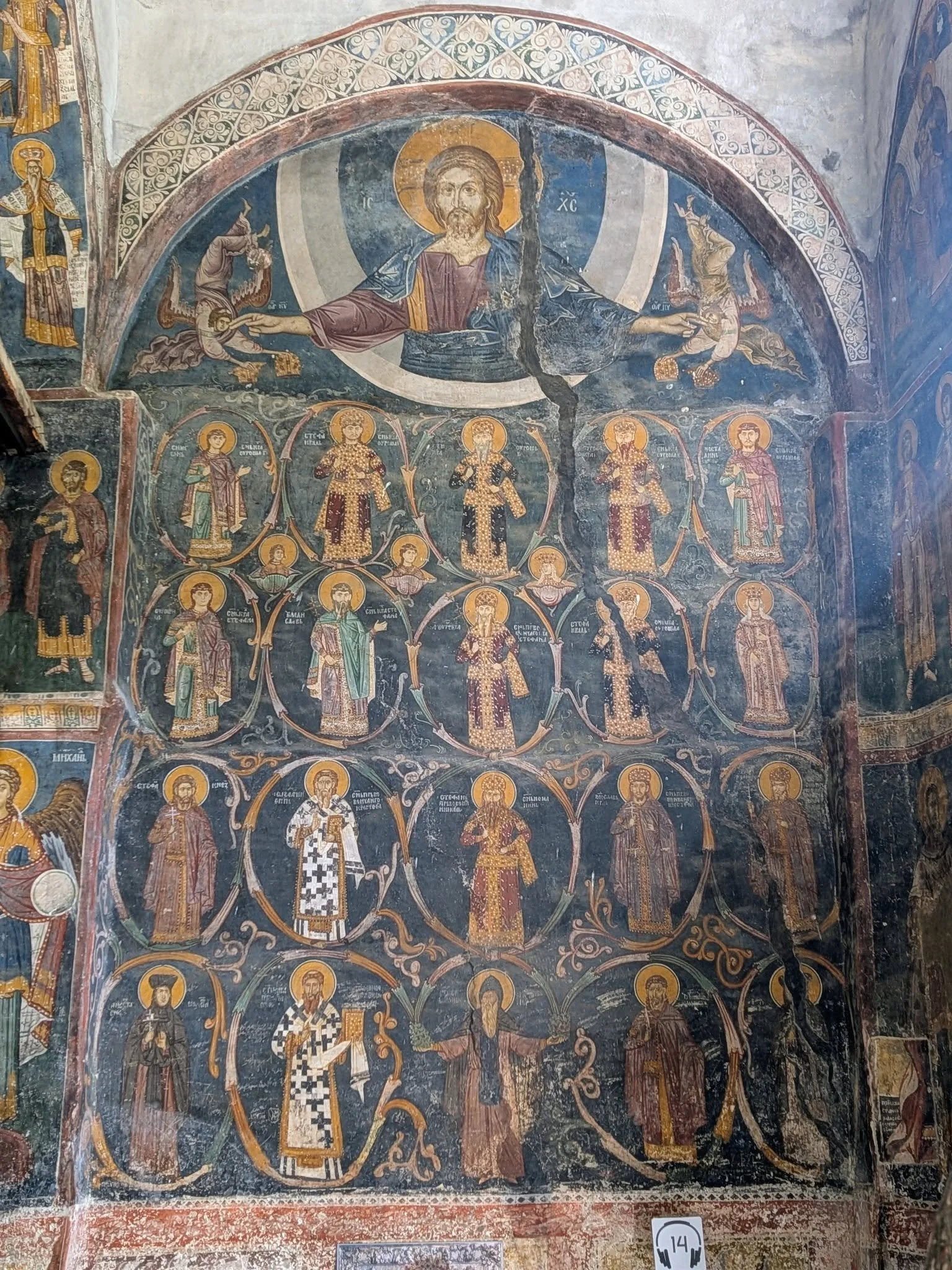
The frescoes inside are very fine, and absolutely encyclopedic. Here, as in the other two, the family tree of the most prominent members of the Nemanjic dynasty are presented in their Byzantine-style regalia, in exactly the same style as the Tree of Jesse used to depict Christ’s illustrious ancestors. This feels at least a little blasphemous to a Western Christian, but it says something important about the role of the divinely instituted rulers in Orthodox thought.
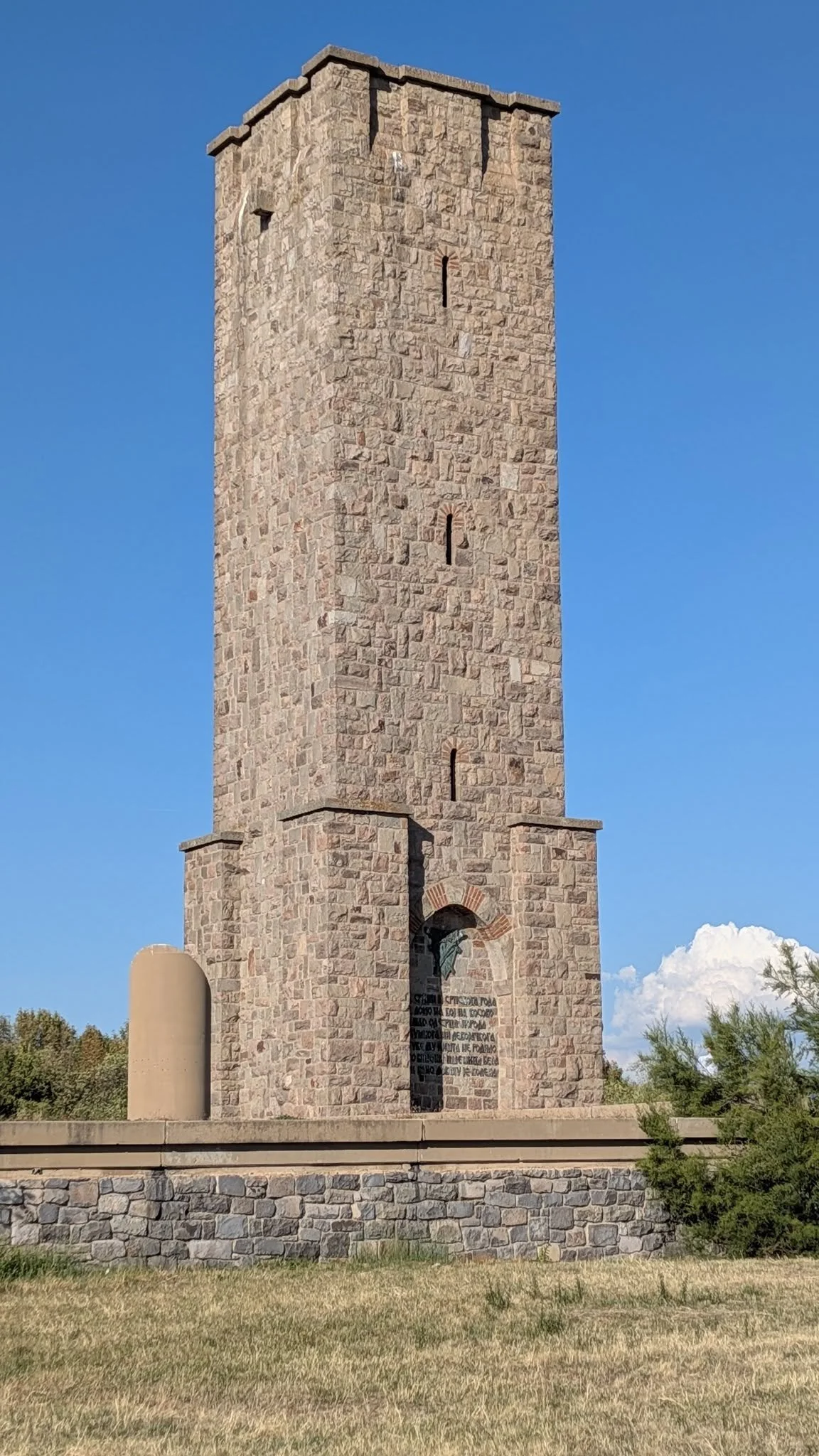

Enroute to Gracanica, I made a stop at the forlorn Gazimestan Monument just outside Pristina, which commemorates the ill-fated 1389 Battle of Kosovo, fought on the nearby “Field of Blackbirds.” Unlike in America, battlefield monuments, especially great towers like this one, are quite uncommon, given the scale of written history. But few medieval battles have been the cause of so much contemporary misery as Kosovo, which was chosen by the Ottomans as the name of the district and which plays a key role in Serbian cultural memory. When not draped with a multi-storey banner of Prince Lazar, the heroic leader of the defeated Serbs, one can see an inscribed curse (supposedly uttered by Lazar before the battle) on any Serb who fails to come to the defense of his homeland. This curse ranges Biblically in its proportions: let his wife be barren, his fields bear no crops, may he have neither white flour nor red wine, etc.
It is strange to see a monument to what is remembered as a devastating loss (even if this is now disputed by historians), the sad end of Christian rule in the Balkans. But it was also the site of a famous speech by Milosevic in 1989 that launched the disintegration of Yugoslavia, so many years of bloodshed in revenge for the defeat here 600 years before. We don’t generally remember medieval battles, but this one is impossible to forget. I had intended to also visit the nearby tomb of the Ottoman Sultan Murad, a tribute to the victorious side’s story, but it was closed (though still very impressive from the outside).


I finished the day at Gracanica, an elaborately designed assemblage of domes and arches, with a similar encyclopedic array of frescoes. I had a long talk afterwards with the young curator, a Kosovo Serb who must have been a very young child when the war here raged in 1999. He was eager to tell me the Serbian side of the story, assuming that American propaganda had flattened the story into a mere catalog of atrocities by his people. I knew much of this already, which I think surprised him. I was living in Athens during the war 25 years ago, and had many long conversations over glasses of ouzo with Dragutin, a young Serbian student who, like me, frequented the Anglican church.
He said that tensions between Albanians and Serbs still remain extremely high in Kosovo and cited lots of grievances about discrimination against Serbs. Most of his countrymen would probably still prefer that Kosovo be part of Serbia, he said, but they knew this was impossible. People were mostly troubled by high unemployment and runaway inflation. He was grateful to have a job doing what he loved, and said he was surely going to steer far from politics, which had been the cause of nothing but suffering in his lifetime.
It gave me much to think about over my final meal here, at a nearby “ethno-restaurant,” some spicy Serbian salad, roast veal, plum pie, and a glass of honey brandy, sweet and strong.