(North) Macedonia
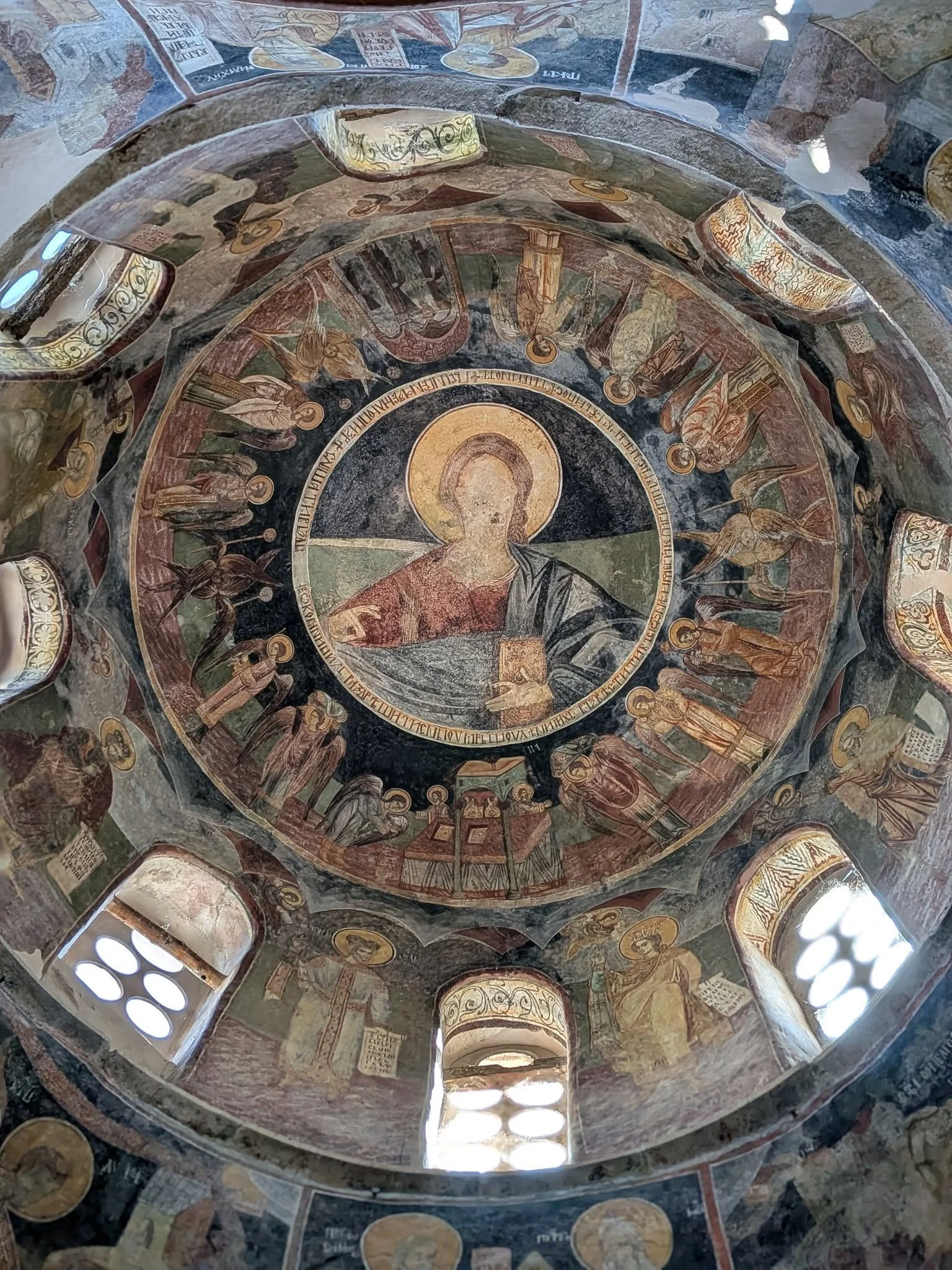
Dome Fresco, Church of St. Panteleimon, Gorno Nerezi
It’s been a delight to be back in the Balkans for a few days, this time in (North) Macedonia and Kosovo. I have really enjoyed visiting other parts of the region in recent years, and only really discovered what I had missed while reading up on Byzantine history to prepare for the pilgrimage I led to Turkey last summer. Many of the great artistic treasures of the high Byzantine period are here, commissioned by Byzantine authorities and Serbia’s Nemanjic dynasty, in its period of greatest flourishing.


I flew into Skopje, the capital of North Macedonia, and visited first the Memorial House of Mother Teresa, who was born in the city as Gonxhe Bojaxhiu in 1910. The great modern saint represents Macedonia’s ethnic diversity (this is why the French call fruit salad “macedoine”), as she grew up as an Albanian-speaking Catholic in land dominated by Macedonian (or Bulgarian)-speaking Orthodox Christians. There’s also a significant Albanian Muslim population here.
The Memorial House is an unusual building, and not at the saint’s birthplace (which was destroyed long ago), but on the site of the Jesuit-run church where she was baptized. It is partly constructed of stone and intended to resemble a typical Skopje house of the era, but there’s a very modernist chapel on the third storey. On the inside, the building has its logic, but it presents a very strange street profile. There were a variety of exhibits about the saint’s ministry and the way in which its profound witness was gradually recognized around the world. I had not remembered that she began religious life as part of an Irish order, and it was surprising to me to see letters written by her early in her life in English.


I continued on to the Church of St. Panteleimon in Gorno Nerezi, at a beautiful mountain site overlooking Skopje. The small church there was built by a son of the Byzantine emperor Constantine Angelos, in 1164, and the frescoes were likely done by artists from the imperial court. Though damaged in the 16th century by an earthquake, they have been amazingly restored and the colors are very vivid.
Some art historians have described the frescoes as an anticipation of the Renaissance, a century and a half before Giotto. The deep emotion of the lamentation fresco, with Mary cradling the dead Christ in powerful grief, is very striking. I also thought the icon of Saint Panteleimon, the patron of doctors, was beautifully composed. At the bottoms of the walls and in the scene of the Presentation in the Temple, the artists have frescoed in marble facings, like the grand ones in the Hagia Sophia, some of them in the same “bookend” style one sees there, with identical cuts facing each other.


On the mountains on the other side of the city, I visited the Monastery of King Marko, a fourteenth century site, which is remarkably well-preserved, given the war-scarred history of the region. Marko was never crowned, but dominated this region in the mid-late 1300s in the name of Serbia, whose kingdom was then in tatters. He is a recurrent figure in Balkan folklore, as a man of superhuman strength who rode a wine-drinking horse, and defended the weak from their Turkish oppressors. The only surviving portrait of him in life is on the donor panel on the church’s south porch.
The frescoes inside are quite well preserved. They lack the elegance of the Gorno Nerezi church’s paintings, but are full of vigorous figures, with lots of narrative detail in each scene (they reminded me of the roughly contemporaneous Chora Church in Constantinople in this respect. I was quite impressed by the Persian caps of the three wise men, and Saint Demetrius, the military saint to whom the church is dedicated, cut a Marko-like dashing figure over the door. A nineteenth-century vine-draped outer porch proved a pleasant shady spot for a ponder on this warm day.


I also visited the ruins of Heraclea Lyncestis, a city founded by Philip of Macedon, the father of Alexander the Great, in the 4th century BC. It was an important center on what the Romans would call the Via Egnatia, the major east-west road through the Balkan peninsula. Most of the ruins were from the 5th and 6th centuries AD, when it was the site of a major bishopric before being decimated by an earthquake and then the invasion of the Slavs. There is a large theatre (the presence of animal pits and high barriers between the seats and stage show it was probably more for Roman spectacles than classical drama), and several basilicas of different sizes, as well as an episcopal palace. Several fine floor mosaics are preserved as well).
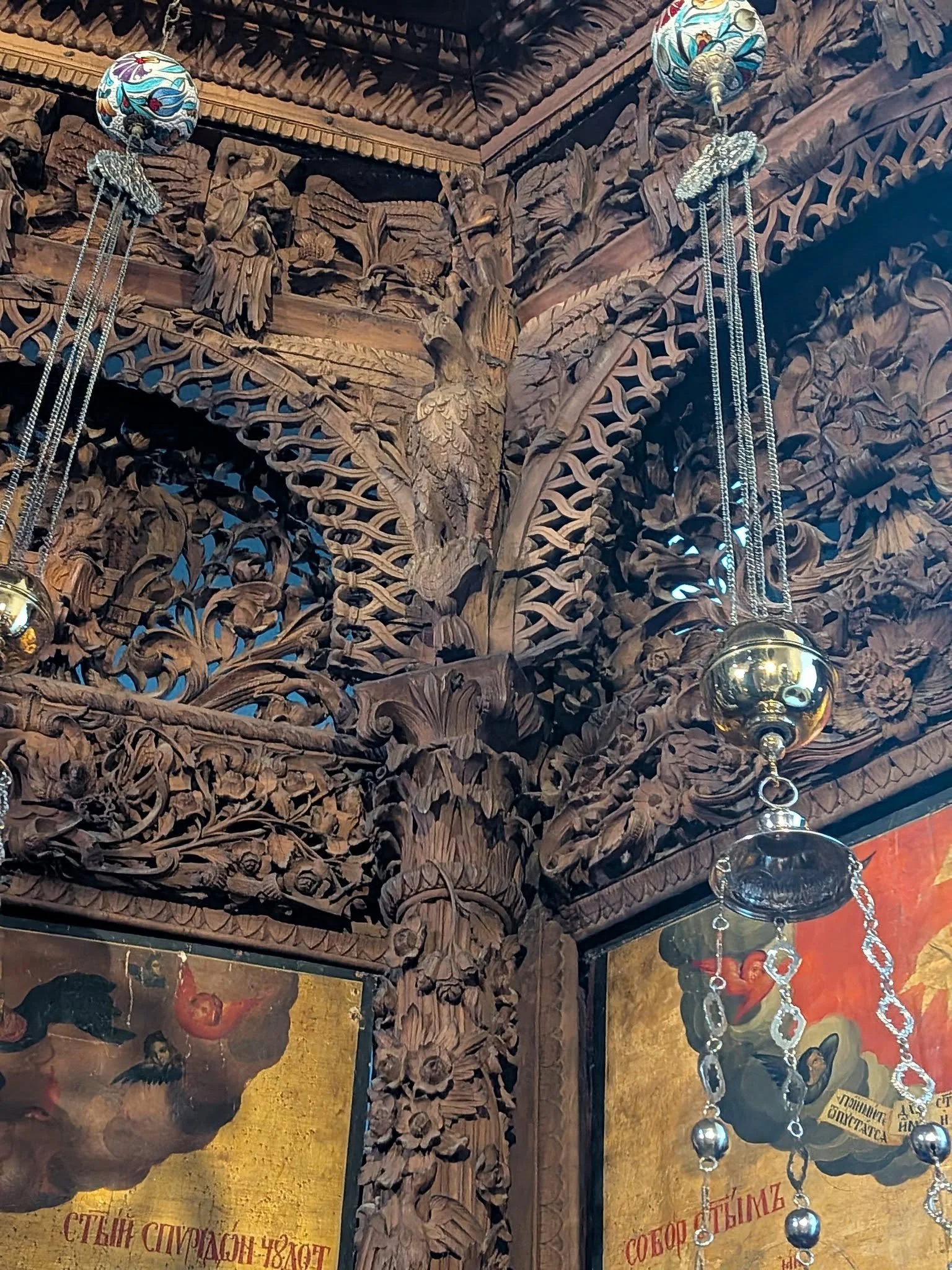


On Sunday morning, I visited the Monastery of St. John Bigorski, which is located on a majestic mountaintop in the Mavrovo National Park, near the Albanian border. An 11th century foundation, the monastery was rebuilt in the 19th century, after being destroyed by the Turks, and is one of the most revered in Macedonia (which is saying something because monasteries seem to be everywhere here). There are more than twenty monks, and they are famed for their singing in the best Byzantine tradition. Despite being in the middle of the forest, there were several hundred people crammed into the church, many of them young, and I was very impressed by how many came forward to make their communions (it was usually just children and old women when I lived in Greece, people not subject to the rigorous fasting rules). The monastery grounds are immaculate and full of flowers.
The church is famous for its intricately carved iconostasis, which is a specialty of the craftsmen of this region, a people known as the Mijaks. Dozens of Biblical scenes, and many different kinds of animals, birds, and plants are depicted, and there is so much under carving that it seems to spring with life. I snapped a few pictures before being scolded by one of the monks. It’s one of those sights that really must be seen to be fully appreciated.
I had a very nice lunch afterwards at “the House of the Mijaks” a restaurant specializing in local delicacies. Mijak food, like Swiss food, seems to lean heavily on dairy products (all that herding on land too steep to farm), and I think once in the Alps I was served something much like the dish of pork and mushrooms in cream sauce with cheese. After the meal, I had an excellent cup of “Constantinopolitan coffee,” a precise locution that fits Macedonia perfectly, giving credit neither to the Turks or to the Greeks, but to the great imperial city so fondly remembered in its great monuments.
The monastery was in the middle of a national park, but grand mountains have been a feature throughout my travels here, which explains the relative isolation of the region. The main roads seem to be perched between sharp cliffs and deep river valleys. I thought more than once of the brave workmen who created roadways in such dramatic settings and of those who must repair them each year. My only sadness was missing the fall colors, probably only by a few weeks. My next trip to Macedonia must be in October.