Tarsus & Antioch

The Church of St. Pierre, Antakya
I’m traveling again, this time in Southeastern Turkey, to a number of ancient cities with deep Biblical associations, many of them places I have read about for many years.


I began in Tarsus, the hometown of St. Paul, which was a very ancient city in his time. The local legend says it was founded by Seth, the son of Adam, and I saw his tomb in the Ulu Cami (the Great Mosque), which is also decorated by some fine classical columns that St. Paul may have known. The town also includes a mosque built around what is said to be the burial place of Daniel (his very large tomb draped in a beautiful green cloth embroidered with gold). I also visited St. Paul’s well, which is said to be at his birthplace, and I visited the only church left in the city, actually a museum now, also dedicated to St. Paul. I said Evening Prayer there, and one of the lessons happened to be the account of his conversion from Acts 9 (including the first mention of his hometown).


On Tuesday, I left early and visited the ruins of Anazarbus, the capital of Cilicia during the early Byzantine period, which was ruled in turn by the Abbasids, the Crusader Princes of Antioch, and the Armenians, before being thoroughly destroyed by the Mamelukes in the 14th century. The sixth century gate of the city has been reconstructed, and there is a long stretch of ancient street, framed by colonnades and some ruined churches. There is also an impressive crusader castle on the hill above, but I could find no way up that didn’t involve rock-climbing skills I don’t have. I seemed to be the only visitor to the site, and the approach was via local dirt roads. I almost drove onto the ancient street by accident, and shared the ruins with some cows and goats.
I did make it into a nearby castle of the same era, Yilankale, or Snake Castle, which offers amazing views of the Cilician plain. The path stopped at the lower entrance, and there was a fair bit of scrambling over the rocks to make it into the keep, but the name didn’t hold up -- only lizards in sight.


I headed south, a beautiful drive right along the Mediterranean coast for much of the way, and made a brief stop at the “Jonah Pillar,” a pile of ancient rocks that is said to mark the spot where the prophet was spat out by the whale. In truth, it’s a fairly straight shot (with lots of walking) from that bit of coast to Ninevah, in what is now be Northern Iraq.
I made my way around Musa Dagh (Moses Mountain), which is famous due to the heroic resistance of Armenian rebels there in 1915, during the Armenian Genocide. The mountain got its name from another ancient legend with a landmark, the Moses Tree in the village of Hidirbey. The story is that Moses stopped to drink from the local stream, and placed his staff in the ground, and it promptly put down roots and sent out branches. It is an enormous and very ancient-looking tree, and the “water of immortality” one drinks from the pump there had a good taste (as did the lemon sherbet served in the tree’s abundant shade).


I was headed for Antakya, ancient Antioch, one of the greatest cities of the Empire in the time of Christ, and the historic capital of Syria. Little of the ancient city survives due to a series of devasting earthquakes, with the worst of them in 526, and then in February 2023. I stopped at the ancient city’s seaport, Seleucia Pieria, where an immense tunnel was built by Roman engineers as part of a water diversion system to keep the bay from silting up. Part of the city’s ancient necropolis also survives, tombs cut into the soft local stone, some with weathered columns and pediments.
I also visited the ruins of the Monastery of St. Simeon the Younger, a fifth century stylite, who lived on a pillar for many decades, delivering fiery sermons and gathering a community of monks, who built their monastic complex around the pillar. He was not as famous as his namesake of Aleppo, but still attracted quite a crowd. The pillar survives (in somewhat shorter form) and there are some striking ruins of the surrounding chapels and halls, all perched atop a dramatic mountain.
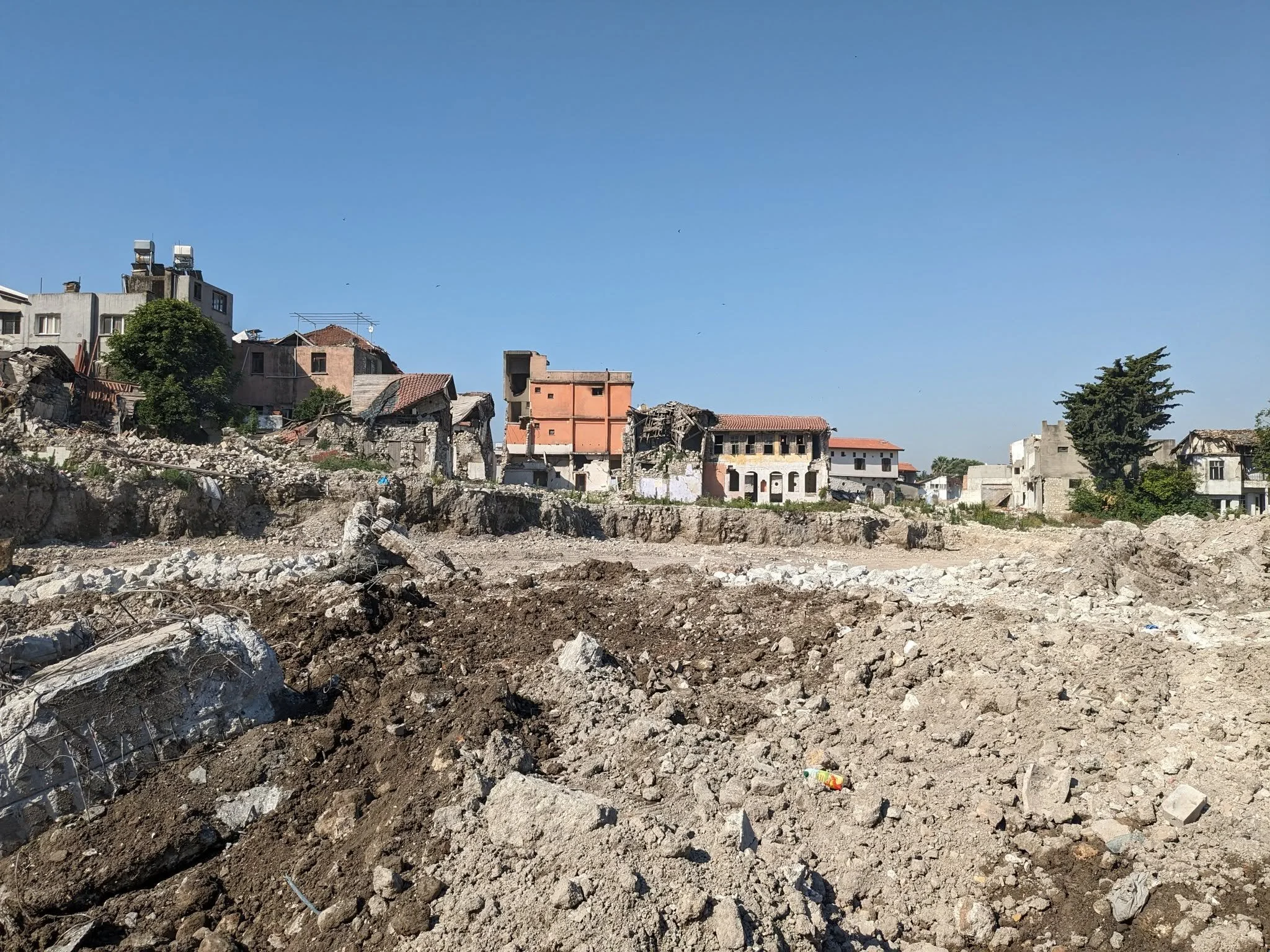
Earthquake devastation, Old City of Antioch
I wondered after arriving in Antakya if coming there had been the right thing, but everyone I talked with seemed delighted to see me. Most of the old city was destroyed, and the demolition is far from complete. I don’t think I’ve ever seen a city in such a state of destruction that is still inhabited. Navigating around the city is hard because so many roads are blocked with debris. Most of the historic churches and mosques were a total loss, as was the archaeology museum, but they are all being rebuilt.
Everyone I talked to about it was very dispirited. The hotel clerk said he had been out of town when it happened, but made it back to help his family in two days, getting there before the first government assistance. The owner of the restaurant where I had supper talked with me for a long time. Inep had spent two years in Baton Rouge, Louisiana as a college student, and tries to keep up her English. She said I was the first English-speaking diner she had seen since the earthquake 18 months ago. Her restaurant, which specializes in the city’s unique Syrian cuisine had been in a historic house downtown and had to move to a modern space 7 miles away. I asked if she thought she would move it back in time. “We will see,” she said, predicting it would take 20 years for things to get back to normal. The city was also a model for religious tolerance in Turkey, with about a 25% Christian population and large numbers of Shiite Muslims. But so many have moved away, that it’s hard to say if this can be restarted again.
I finished my time in the city by visiting the Church of St. Peter, spared by the earthquake because it’s a cave in the side of the mountain above the city. It is said to be the first place for worship for the Christians in the city, where “they were first called Christians” (Acts 11:26). I said Morning Prayer in the church (which I had all to myself, like nearly all the other attractions), praying especially for the rebuilding of this city and its rich culture, and for the persistent witness of its Christians, in this place so important in the early life of the Church.