The Tur Abdin

Church of the Virgin Mary, Hah
I have been visiting the monasteries and villages of the Syriac (or Assyrian) Christians of the Tur Abdin (the Mountain of the Servants of God). There are about 30,000 of them in Turkey, and this is their traditional homeland (though about 2/3rds of them are now in Istanbul). They speak a dialect of Aramaic, the same language that Jesus spoke, and traditional Aramaic, written in Syriac characters, is their liturgical language. They are also called the Jacobites, for one of their early leaders, Jacob Bardaeus. They broke with the Orthodox Church of Constantinople in the fifth century over the Christological doctrine of the Council of Chalcedon (though these differences have since been mostly reconciled). At one point, there were 600 monasteries in the region and enough parishes for four dioceses, but in one village I visited, there are just five families left, in another, ten.


There are two large and well-maintained monasteries, Deyrulzafaran and Mor Gabriel, and I visited both of them. Deyrulzafaran was the seat of the Patriarch of Antioch, the head of the Syrian Orthodox Church, and his throne still stands in the chancel. I had tea with one of the monks, Father Gabriel, and joined him and the young men who study at the monastery for Evening Prayer, with lots vigorous chanting in Aramaic.


Mor Gabriel was especially notable for its Byzantine mosaic in the chancel, with beautiful swirling vines and crosses that reminded me of those at Ravenna, as well as an early depiction of a Christian Altar. Mor Gabriel dates back to the fourth century, and Deyrulzafaran from about a century later, though the crypt is said to be the remnants of a temple to the Mesopotamian sun god Shamash.


I visited four villages as well, each of which had a church of great antiquity. The Church of the Mother of God at Hah, they claim, is the very oldest church, because it was built by the wise men on their journey home. It certainly looks very ancient, and is said by the historians to be partly a converted Roman temple. Like many of the churches, it is adorned with heavily carved, worn columns and also has a remarkable pyramidal dome that looks like a small house, with its own series of decorated columns.
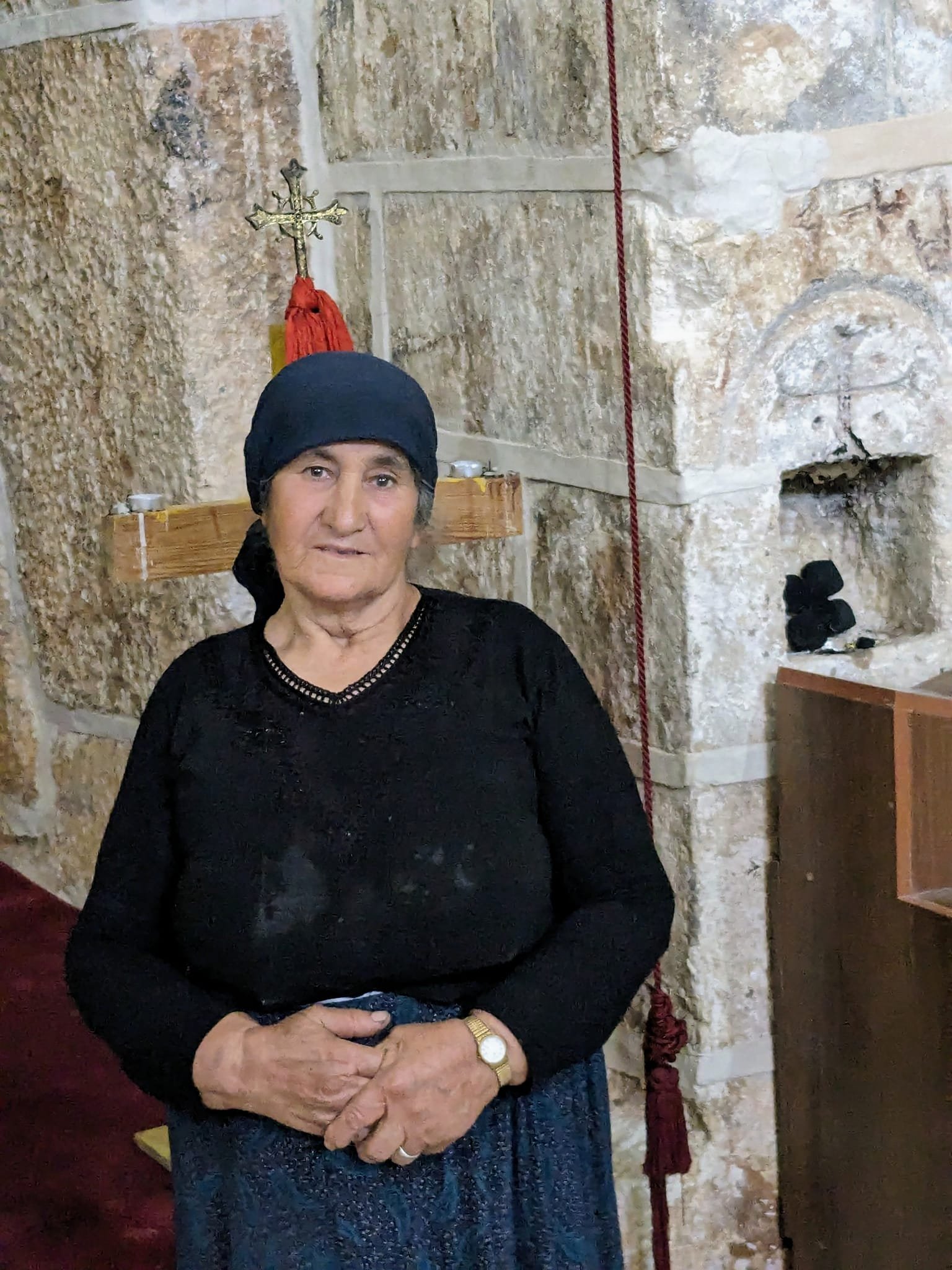


The Church of Mor Hadshabo looks like a fortress, and with good reason, as it was the staging point for the Syrian Christians’ most successful resistance battle with the Ottomans in 1915 during their own genocide (one far less known than that of the Armenians). The caretaker there, Guldet, was delighted to have a priest as a visitor and insisted that I chant a prayer.
It had a very vertical and impressively carved altar niche, which looked a great deal like a mosque’s mihrab. Some of the oldest churches, like the one at Hah, lacked these. The churches are generally very sparse in their use of figural painting, and I saw no sculpture. Most decoration is in weathered decorative sculpture, which is part of what makes them seem so timeless.


I went up on to the extensive roof of Mor Azozel, which has an extensive walled complex, and includes one of the traditional outdoor instruction areas for children with stone lecterns to hold the books. Mor Yakub in Salah is a very thriving place, with some new buildings and restored ancient wall paintings. I had been told to meet the priest, who speaks English and is active on Instagram, but he was away on business.
The maintenance of the churches, I was told, is generously supported by the Syriac Christian diaspora, in Germany, Sweden, and the U.S. I met my only English-speaking tourist of the trip, an Englishman who married a German Syriac Christian, yesterday at Deyrulzafran Monastery. I know that the community here faced dire threats only a few decades ago, and it seems more prosperous and well-established than I had expected. But there are very few monks, and economic prospects continue to make migration very attractive. I worry how long there will be a vibrant Christian presence here, in one of the world’s original heartlands of Christian spirituality and learning.